AEC Case Study
PLACEHOLDER
Kai Hattendorf documents a fundamental shift in the way AI will influence the future of events: rather than primarily being a suite of tools for organisers, AI’s most impactful role will be in how younger delegates use it long before the event starts to guide their entire decision-making on whether and how to participate.
Associations have only a few weeks left to prepare and submit entries for this year’s programme, with US$25,000 in grants on offer. Co-organised by BestCities Global Alliance and ICCA, Incredible Impacts encourages associations to share the innovative ways in which their meetings generate societal value, locally and nationally where the meeting takes place, or worldwide.
The program is fully operational as of 10th April and replaces traditional passport stamps with a digital system, designed to increase security, and make border checks faster and more efficient. Border control agents will collect fingerprints, take a facial image and ask for travel information of non-EU nationals who are visiting European countries. From Northstar…

David Adler, Gathering Point News, explores the rationale for establishing the Centre for Events & Festivals as a response to a fragmented events industry, weak knowledge-sharing, and limited use of evidence. The organisation aims to bridge academia and practice, strengthen collaboration, and promote more sustainable, inclusive, and community-focused approaches to event design and delivery.
CEMA Summit is the annual moment that brings the world of event marketing together to compare strategies. We test ideas, we track lessons learned, and we unpack the best practices emerging as the industry evolves. Join event marketers from around the globe for three days of practitioner-led education, global case studies, and candid, future-focused conversation.
As geopolitical instability continues, organisers are under growing pressure to respond quickly, communicate clearly and reassure clients when disruption strikes. Boardroom’s Vicky Koffa interviews Kenes Group CEO Ora Lahav on why crisis readiness should no longer be treated as an occasional capability, but needs to become part of an international event organiser’s everyday operating mindset.
Destinations International has released a comprehensive new resource designed to help destination leaders strengthen relationships with residents and stakeholders while advancing long-term community alignment. Grounded in insights from the Futures Study and shaped by global industry leaders, the Destination Professional’s Guide to Community Engagement offers a practical framework to help destination organizations measure meaningful impact.
City Nation Place has released a benchmarking report into the different approaches taken by a range of destinations to build competitiveness in attracting and retaining talent. There are certain to be many lessons that can be taken on board when designing business event strategies that share this same objective.
PCMA Insights, a resource for business events leaders has been released, designed to help make sense of an increasingly complex business environment. Also available to download is PCMA’s flagship annual report on how event strategists in companies and associations, and destination leaders in city and national DMOs worldwide are planning, designing and leading through 2026.
The Events Industry Council (EIC), in collaboration with the Joint Meetings Industry Council (JMIC), has launched a targeted refinement of the EIC Sustainable Event Standards (SES), representing an important opportunity to further strengthen alignment across the industry’s leading sustainability frameworks. Contributions are welcome until 12 April 2026.
Boardroom’s Vicky Koffa and Remi Deve summarise the key issues, opportunities and challenges discussed at the recent EAS 2026, all of which provide vital insights for business events suppliers and destinations interested in better understanding the current thinking and priorities of their association clients. An important conclusion: collaboration has become a strategic necessity.
With support from Thailand Convention and Exhibition Bureau, RX is readying its IBTM series for another foray into the region after Covid-era knockbacks in Singapore and reportedly dim market expectations in Hong Kong. Bangkok International Trade & Exhibition Centre will host IBTM APAC, 9-10 June 2027, intensifying competition among APAC event organisers and host cities.
On 9th March, Mohamed Mezghani, secretary general of Union Internationale des Transports Publics, cancelled the organisation’s 2026 Summit in Dubai, scheduled for April 21–23. Unlike other regional events that have been postponed, the summit, expecting 8,000 attendees, will not take place. During Skift Meetings’ LinkedIn Live on 31st March he described the decision as “heartbreaking.”
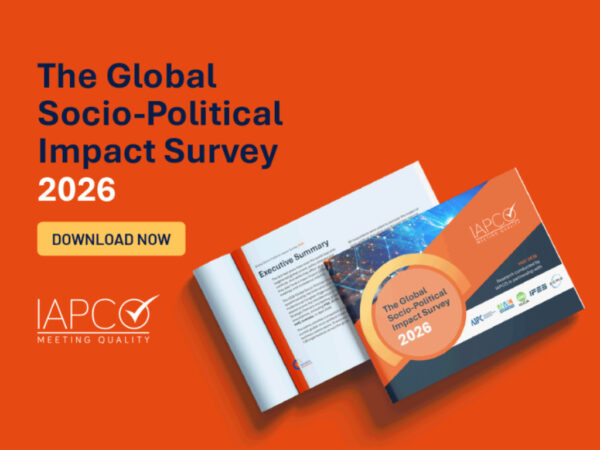
This second edition globe survey is being conducted in collaboration with IAPCO, AIPC, AMCI, IFES and PCMA, to understand how the business events sector is being impacted by the current geopolitical and economic environment. Deadline for submissions is 10 April 2026!
ICCA CEO Dr Senthil Gopinath argues that despite all today’s geopolitical pressures, associations can still remain both neutral and resilient. But what they have to accept is that disruption, uncertainty and ongoing threats are the “new normal”, not anomalies that will swiftly pass on by. From Boardroom…
M&C Asia magazine examines the changing picture of global rankings in passport power (how easy it is for holders of a particular passport to visit other countries) and border openness (how restrictive countries are to holders of different passports), and explains the implications for destination competitiveness for international business events.
Sumaira Isaacs analyses the 5-decades long-term vision that underpins the UAE’s economic strategy, and argues that what makes UAE different is not just resilience, it is preparedness embedded into infrastructure, policy and execution. Business Events may have short-term disruption, but remain central to the delivery of many of UAE’s strategic developmental objectives.
Findings from the newly released Northstar Meetings Group/Cvent PULSE Survey (APAC), conducted in March 2026, show geopolitical and economic risks rising to the top of planners’ concerns, reshaping sentiment across the region. Despite this, demand remains resilient as the region’s planners continue to actively source and book events.
Powered by