Prof. Liam Glynn of Limerick University shares the remarkable journey to impactful change from his remote General Practice in Ireland’s Ballyvaughan, County Clare.
Starting from the creation of a political movement – No Doctor No Village – reversing post-GFC rural healthcare policy in Ireland. Attracting one of the world’s leading rural healthcare conferences to Limerick to ensure lasting change. And concluding with an invitation to host a WHO meeting to shape the Global Rural Health Equity Toolkit.
Sally-Ann O’Brien, Business Events Manager Fáilte Ireland commented, “Association conferences, like Rural WONCA, play a vital role in driving societal progress and fostering innovation. Fáilte Ireland has embarked on a journey to harness this potential, leveraging a framework and structured methodologies to unite stakeholders to define, measure and amplify the broader value of conference impacts. Fáilte Ireland was proud to support Rural WONCA 2022 – a conference that promoted long-term sustainability in rural healthcare across Ireland, changing attitudes, lives, health and ultimately, the world.”
Liam Glynn, Fáilte Ireland Conference Ambassador and Chair, Local Host Committee, Rural WONCA, and The Iceberg, in collaboration with Fáilte Ireland, share Limerick’s fast-track to intellectual capitalism. As the National Tourism Development Authority, Fáilte Ireland’s role is to support the long-term sustainable growth of the economic, social, cultural and environmental contribution of tourism to Ireland. Ireland recently launched its new business events strategy, ‘Business Events 2030’, which outlines a strategic roadmap to strengthen Ireland’s business events sector, focusing on economic growth, social impact and environmental sustainability. Hosting Rural WONCA in Limerick aligns with the strategy, which aims to use conferences as catalysts for positive change.
Rural WONCA 2022 – ‘Improving Health, Empowering Communities’
Hosted by the University of Limerick, the World Rural Health Conference 2022 united global healthcare professionals to explore and address rural health challenges. Held from 17th-20th June 2022, the World Rural Health Conference – the first of its kind in Ireland, provided a platform for stakeholders to explore the theme of ‘Improving Health, Empowering Communities’. This theme supported WONCA’s mission to improve healthcare access, facilitate knowledge exchange, and promote sustainable healthcare.
This annual event, created by the World Organization of Family Doctors (WONCA), gathered experts such as GP’s and medical professionals, policymakers and government agencies, and academic and research institutions to tackle rural healthcare issues.
Ireland, with one of the highest rural populations in Europe, was the perfect host destination for this event. The event showcased strong leadership from the Conference Chair, Professor Liam Glynn, and the organising committee at the University of Limerick and the Shannon Region Convention and Sports Bureau. Organised by the General Practice discipline at the University of Limerick’s School of Medicine, in collaboration with WONCA, the Irish College of General Practitioners and the Rural, Island and Dispensing Doctors of Ireland, the conference promoted many important rural health initiatives.
The creation of the Limerick Declaration, central to the WONCA impact story, aims to improve healthcare in rural areas, nationally & internationally.
The Global Financial Crisis and the Need for Change
The global financial crisis of 2008 was a wake-up call for many sectors, including healthcare. Rural communities, often the most vulnerable, were hit hardest. The crisis illustrated the urgent need to decentralise healthcare and bring it back to the local communities. These communities, isolated and struggling, needed a lifeline. This was the backdrop against which the Limerick Declaration on Rural Healthcare began to take shape.
Political Journey and Grassroots Campaign ‘No Doctor No Village’
It was the grassroots campaign, “No Doctor No Village’, that led to the Limerick Declaration. The objective of the campaign was to ensure that rural healthcare became a political priority. The campaign was a testament to the power of community activism. The campaigners, driven by a deep commitment to rural healthcare, managed to hold power and influence the Select Committee for Health.
The Limerick Declaration: A Beacon for Rural Healthcare
The Limerick Declaration emphasised the importance of accessible healthcare in rural communities, highlighting both its economic and social benefits. It underscored the interconnectedness of rural services and the resilience of these communities. The National Committee for Rural Health, chaired by a dedicated leader, played a pivotal role in this process.
The journey towards the creation of the Limerick Declaration was a year-long process involving extensive input from various stakeholders. The declaration aimed to address the unique challenges faced by rural healthcare systems and was finalised just in time for the World Organization of Family Doctors (WONCA) gathering in 2022. The intention was to shape the declaration during the conference, and the final version was presented for endorsement and later underwent peer review.
Below, Glynn explains the pathway to change:
Legacy Intentions:
The conference supported Rural WONCA’S long term impact intention – to improve rural healthcare access, through the expected outcomes.
Rural Healthcare Needs and Delivery:
- Conduct a national health needs assessment for rural healthcare.
- Ensure rural services provide accessible first contact care.
- Invest in rural healthcare infrastructure to improve working conditions and fund innovative technologies.
- Properly fund essential rural services like medication dispensing.
- Develop rural academic infrastructure in medical schools to support community-based education and transformative learning.
Rural Workforce:
- Build a diverse, inclusive workforce committed to social accountability, gender equality, and social justice.
- Fund a new undergraduate medical program for rural and remote locations.
- Implement targeted admission policies to enrol students with rural backgrounds.
- Develop LICs in general practice with a focus on rural practice, ensuring 25% of clinical placements are community-based.
- Create a specific rural curriculum within GP training, recruiting and retaining rural GP trainers/mentors.
- Establish postgraduate Rural General Practice fellowships funded by NDTP and HSE.
- Base medical school and postgraduate GP training on curricula that include rural context and effective practice criteria.
- Ensure guaranteed parental leave and family-friendly workplaces for rural healthcare practices.
Advocacy and Policy:
- Include rural communities and organisations as key stakeholders in rural health policy.
- Develop a unified policy to promote rural health at national, regional, and local levels.
- Foster inter-sectoral collaboration for primary healthcare, including investment in training and career pathways.
Research for Rural Healthcare:
- “Rural proof” health research with a designated percentage of funding.
- Utilise media to share research outcomes and build national awareness of rural health issues.
Key Outcomes:
The World Rural Health Conference had a strong impact on rural healthcare in Ireland. Here are some of the key highlights and outcomes:
- Established Ireland’s first ICGP National Standing Committee for Rural General Practice.
- Appointed the first ever Professor of Rural General Practice at the University of Limerick.
- Created a novel Rural GP Fellowship programme, supported by a €1.4 million investment from the Health Service Executive (HSE).
- Developed a new Rural Teaching Hub at University of Limerick’s School of Medicine, allowing students to spend 25% of their clinical training in rural communities.
- Published the “Limerick Declaration on Rural Healthcare”, a blueprint for improving high-quality healthcare in rural and remote areas nationally and internationally.
- Hosted the WHO global meeting on the development of a Rural Health Equity toolkit.
- International Medical Graduate Programme: Added 150 doctors to rural healthcare in 2 years, doubling GP growth (1.5% to 3.9%).
- Advocacy led to new locum support for 239 rural GPs, starting 2025.
- Rural Seeds Network: Students/doctors collaborated with experienced professionals, with 50 students & 5 Ukrainian refugee doctors attending/presenting at the conference.
- Rural Ambassador Programme: Provided scholarships to doctors from lower income countries who contributed to Limerick Declaration & presented at the conference.
Conclusion
Limerick University has emerged as a global leader in rural health education and research. By developing and implementing the Limerick Declaration, the university has positioned Ireland as an intellectual capital for rural health. The toolkit created as part of the declaration is now being applied internationally, demonstrating its global relevance and impact.
The recruitment and relocation of 150 healthcare professionals through the International Medical Graduate (IMG) program have significantly improved healthcare services in rural communities. This initiative has fostered a circular economy of best-in-class rural healthcare, benefiting both the community and the electorate. The declaration has made rural health—and by extension, rural development—a central political issue, ensuring continued focus and investment in these critical areas.
In conclusion, the Limerick Declaration on Rural Healthcare stands as a beacon of hope and progress for rural communities worldwide. It underscores the importance of accessible healthcare, the power of grassroots activism, and the role of academic institutions in driving meaningful change. The journey from the global financial crisis to the establishment of Limerick as an intellectual capital for rural health is a testament to the resilience and determination of those committed to improving rural healthcare.
Overall, by using the conference as a platform, Rural WONCA 2022 exemplifies how business events can be leveraged to enhance health education, drive economic development, and create social impact.
About Fáilte Ireland
As the National Tourism Development Authority, Fáilte Ireland supports the long-term sustainable growth in the economic, social, cultural and environmental contribution of tourism to Ireland. ‘Meet in Ireland’ is the official business events brand for the island of Ireland. It facilitates a partnership between Failte Ireland, Tourism Ireland and Tourism Northern Ireland to promote the island of Ireland overseas as a world class business events destination. Ireland’s new business events strategy, ‘Business Events 2030’, is a product of collaboration between the Department of Enterprise, and Employment, Fáilte Ireland, Tourism Ireland and industry leaders from the tourism sector.
Further Reading:
Fáilte Ireland Case Study Series | Case Study #2: IGC 2024 Dublin: Celebrating a World of Difference, Creating a Lasting Legacy
UPDATE: NOVEMBER 2025
After this Case Study was published, WONCA made a submission to the Incredible Impacts Programme 2025 which resulted in a $20,000 USD grant being awarded for future projects:
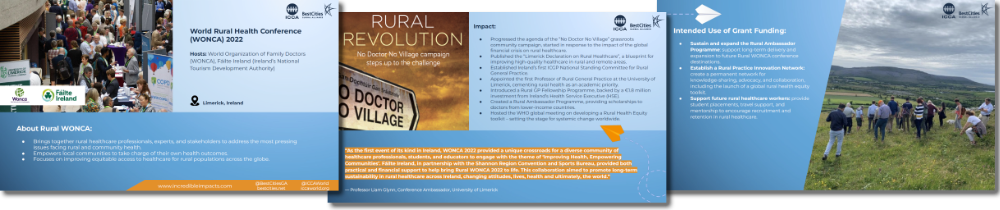
Read more here: Rural Doctors Conference Scoops $20,000 Impact Prize
Prior to public voting commencing at ICCA Congress 2025, Professor Liam Glynn presented the WONCA legacy story, captured by The Iceberg: