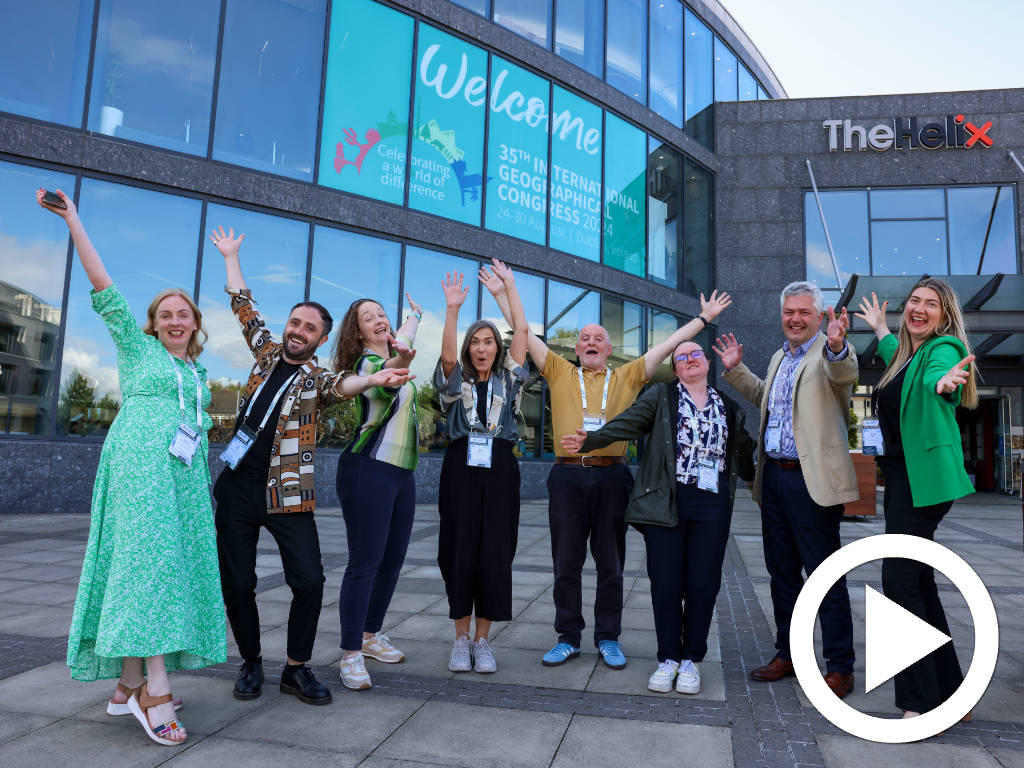
In August 2024, Dublin became the global capital of geography. The 35th International Geographical Congress (IGC 2024) brought 2,654 delegates from 74 countries and five continents to Dublin City University (DCU) for a week-long celebration of research, collaboration, and connection under the theme “Celebrating a World of Difference.” The conference was supported by Fáilte Ireland, the National Tourism Development Authority and Dublin Convention Bureau, where both practical and financial support was provided to ensure the conference was a success.
The success of the congress was made possible through the collaboration of several organisations, including the expert delivery by Keynote PCO, alongside vital support from Fáilte Ireland – the National Tourism Development Authority – and Dublin Convention Bureau. Each played a key role, offering both practical and financial backing to ensure the smooth running of this landmark international event.
What unfolded over those five days was not only a major academic event but also a carefully designed case study in how to purposefully create impact and legacy – intellectually, socially, environmentally, and economically. From inclusive public engagement to innovative sustainability measures and a complimentary exhaust fume of a €6.6 million boost to the local economy, IGC 2024 offers a model of best practice for cities and organisations aiming to deliver purposeful, values-driven international events.
Was the IGC’s mapping of Dublin’s housing pinch-points a forerunner to hosting ISHF in 2025…?
The Origins of a Global Gathering
The journey to Dublin began almost a decade earlier. In 2016, a small Irish delegation led by Professor Niamh Moore-Cherry and Professor Frances Fahy won the bid to host the Congress – a milestone achievement for Ireland’s academic community. There were doubts at the time: could a country of Ireland’s size host an event of such scale and complexity? The answer, as the outcome proved, was a resounding yes.
From the beginning, the organisers saw the Congress as more than an academic meeting. It would be a festival of geography, open, inclusive, and outward-looking – one that would extend beyond university walls and bring geographical thinking to the public sphere. This ethos, grounded in collaboration, creativity, and care, became the defining spirit of IGC 2024.
A Celebration of Collaboration and Diversity
IGC 2024’s programme was immense in both scale and diversity. Over 2,500 talks and 400 poster presentations took place across 30 parallel sessions daily, coordinated by 44 thematic commissions. The Congress attracted both established and emerging scholars, policymakers, and practitioners, creating a fertile space for interdisciplinary dialogue.
The event’s theme, “Celebrating a World of Difference,” resonated through every session and encounter. It recognised diversity – of people, place, and perspective – as a strength rather than a source of division. Professor Moore-Cherry described this as a guiding principle: “We wanted to support intercultural awareness and understanding; promote intellectual diversity as a strength, not something to be censored or challenged; and bring the power of geographic research beyond the congress walls.”
An historic milestone came when Professor Aninditta Datta of the Delhi School of Economics became the first woman from the Global South to deliver a keynote address at an IGC and to be elected to the IGU Executive Committee. Her paper, “Worlding feminist geographies: on genderscapes beyond the Anglosphere,” embodied the congress’s commitment to amplifying underrepresented voices and fostering global inclusivity.
Impact Beyond the Academic Sphere
The organisers of IGC 2024 were determined to ensure the Congress would generate value not only for participants but also for Dublin and the wider Irish public. This ambition materialised through an extensive Public Engagement Programme, delivered in collaboration with Dublin City Council, the Congress’s platinum sponsor.
Three flagship public events exemplified this outreach:
- The City Climate Walk, held at Dominick Street Community Centre, invited citizens to explore Dublin’s changing climate through guided discussion and observation.
- Mapping Ireland Through Time, hosted at the Royal Irish Academy, sold out to a crowd of 150, bridging academic insight with public curiosity about Ireland’s landscapes.
- Dublin: A Writers’ City, at Pearse Street Library, blended geography with literature, exploring the city’s imaginative spaces and attracting a capacity audience.
In total, almost 300 members of the public engaged directly with these activities – a testament to the appetite for accessible, meaningful engagement with geographic ideas. Feedback from participants and city partners indicated that this approach had lasting value, highlighting the potential of academic events to deepen civic dialogue on pressing issues like climate, sustainability, and cultural identity.
This community-facing programme also created visibility for Dublin as a hub of innovation and inclusivity. Dublin City Council’s decision to fly Congress flags along the River Liffey throughout the week symbolised both civic pride and welcome. As one delegate noted, it made participants “feel incredibly welcome and valued – part of the city rather than apart from it.”
Sustainability as a Core Commitment
Sustainability was not an afterthought for IGC 2024; it was embedded in the event’s design from the outset. The Congress was hosted at DCU, located within Dublin City Council’s decarbonising zone, and served as a living laboratory for sustainable event management.
Key measures included:
- Carbon insetting initiatives funded through an optional delegate environmental levy, supporting green projects on university campuses across Ireland.
- Digital-only materials, with the conference app replacing printed programmes, saving thousands of pages of paper.
- Sustainable procurement, including recyclable and compostable lanyards and badges.
- Water and waste reduction, achieved through refill stations, vegetarian menus, and pre-notification for lunch requirements – measures that drastically minimised food waste.
- A groundbreaking hybrid event co-hosted with the Royal Geographical Society in London, enabling shared participation with zero additional travel emissions.
These practices not only reduced environmental impact but also served as a live demonstration of how large-scale academic events can align with the UN Sustainable Development Goals (SDGs), particularly those related to sustainable cities, responsible consumption, and climate action.
Sally Ann O’Brien, Business Events Manager at Fáilte Ireland, remarked: “International conferences, such as the International Geographical Congress, are instrumental in driving environmental progress and leaving a meaningful legacy for host destinations. Fáilte Ireland is committed to unlocking this potential through frameworks and collaboration that help stakeholders define, measure, and amplify the wider impact of such events. We were proud to support the 35th International Geographical Congress – a gathering that championed long-term sustainability.”
Strengthening Ireland’s Academic and Professional Communities
For Ireland’s geographical community, IGC 2024 was transformative. It brought renewed energy and cohesion after years of pandemic disruption. Moore-Cherry reflected on this in her closing remarks: “What we lack in size, we make up for in spirit and energy. This is what we in Ireland call meitheal – pulling together for a collective purpose.”
The sense of meitheal was tangible across the week, as colleagues, students, and volunteers collaborated to deliver an event of international standard. This collective endeavour has reinvigorated the Geographical Society of Ireland (GSI), which celebrated its 90th anniversary in 2024. Plans are already in motion for the Society’s 100th anniversary in 2034, inspired by the networks, visibility, and momentum generated by the Congress.
Another enduring legacy is the launch of the Geography Olympiad for Ireland, initiated as part of IGC 2024 and now established as an annual event for Senior Cycle students. This initiative connects young learners with their global peers, nurturing the next generation of geographers and fostering international awareness from an early stage.
Economic and Reputational Legacy
Beyond the academic and social dimensions, IGC 2024 delivered significant economic impact – estimated at €6.6 million for the Dublin economy. Delegates participated in 16 field trips across Dublin and neighbouring counties, exploring sites such as the Dark Sky Park in Mayo, peatland restoration projects in Wicklow, and cross-border initiatives in Belfast. These experiences deepened participants’ understanding of Ireland’s geography while supporting regional tourism and local enterprises.
A Tale of 2 Meetings?
The Congress also enhanced Ireland’s profile as a leading destination for business events aligned with sustainability and social purpose. Fáilte Ireland has plans to further showcase the Congress as a model of good practice, however, perhaps a hidden legacy of the event was its delivery of a pre-emptive strike to map the social housing needs of the city in advance of Dublin hosting the 2025 edition of the International Social Housing Festival (ISHF), and thus laying the groundwork and data for social housing experts to effect positive change from an event yet to arrive in the Irish capital. Now that could be serendipitous or it could be the greatest lesson in integrated strategic planning by Fáilte Ireland – going from destination marketing to destination development simply by connecting the dots – and then using business events as platforms to realise the Irish government’s social housing policies whilst also positioning Dublin and Ireland as an intellectual capital in geographical mapping…
The report from ISHF 2025 can be viewed here:
ISHF 2025 Dublin – Fáilte Ireland’s Role in Driving Change in Social Housing
A Lasting Message: Geography for Good
At its core, IGC 2024 was about connection – between people, disciplines, and places. It exemplified how academic congresses can transcend traditional formats to generate genuine, multi-layered impact. Moore-Cherry articulated this vision in her closing address:
“You have seen what is central to our DNA in Ireland – the ability to convene, to network, to bring people together for positive purposes. A powerful legacy of this event would be to take the networking and dialogue that has begun this week and build on it in the months and years to come – to use our networks for good, in the service of our discipline but also our society and planet.”
As delegates departed Dublin, many carried that message home. The Congress may have ended, but the conversations, collaborations, and commitments it sparked continue – evidence that IGC 2024’s greatest legacy lies not in what happened during the week itself, but in what will unfold in its wake.
In the words of Professor Moore-Cherry: “We hope that your encounters and the places you have seen this week are just the beginning of your relationship with Ireland. After we all go our separate ways, IGC 2024 will be sustained through the positive memories and experiences that you have had among us.”
About Fáilte Ireland
As the National Tourism Development Authority, Fáilte Ireland supports the long-term sustainable growth in the economic, social, cultural and environmental contribution of tourism to Ireland. ‘Meet in Ireland’ is the official business events brand for the island of Ireland. It facilitates a partnership between Failte Ireland, Tourism Ireland and Tourism Northern Ireland to promote the island of Ireland overseas as a world class business events destination. Ireland’s new business events strategy, ‘Business Events 2030’, is a product of collaboration between the Department of Enterprise, and Employment, Fáilte Ireland, Tourism Ireland and industry leaders from the tourism sector.
Further Reading:
Fáilte Ireland Case Study Series | Case Study #1: TRANSFORMING RURAL HEALTH: A Tale of 3 Meetings