From Thoughts & Observations on Business Events with Kai Hattendorf:
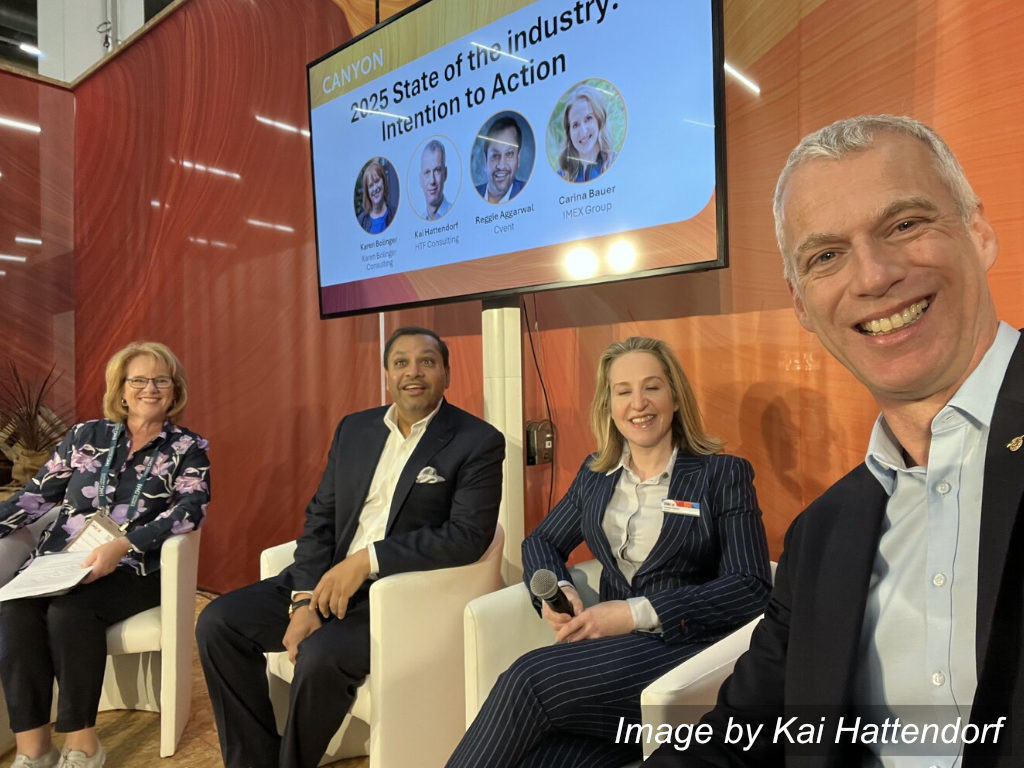
We had a packed house for this session at IMEX last week (with Reggie Aggarwal, Carina Bauer, Karen Bolinger, a very active audience, and me), with participants partly listening from the outside through headphones. So I thought it made sense to do a bigger recap here for everyone.
Trying to tackle “The State of our Industry” in 40ish minutes was a tall task, and we all owe it to Karen who led the conversation that we were able to cover a lot of ground, and with a very active dialogue with many colleagues in the audience.
My main headline – not new, but ever more relevant: change is not looming. It is constant. And it is accelerating. Point in case from Reggie Aggarwal, CEO of Cvent: “AI is moving two to three times faster than the internet did. It’s not about whether it will disrupt us. It’s how soon.”
I admire Reggie for many things, and among them his calm approach to not get overwhelmed. While he acknowledged AI’s pace and potential, he cautioned against alarmism. “AI is going to empower us to do more, to make human connection more efficient, not replace it.” And I know from my own experiences that tech is usually ready way before we are able to apply and accept it properly in business (I mean, I launched what was then called ‘web-tv’ financial reporting for a German news wire in 1999, transmitting through copper cables…it worked, but VERY few people could use it).
A dual picture of disruption and opportunity
Reviewing my notes, I see that we painted a dual picture of disruption and opportunity. On one side: automation, decentralisation, and generative intelligence reshaping roles. On the other side: a refined focus on distinctly human skills like adaptability, creativity, and emotional intelligence.
“If you spend four out of five days on spreadsheets doing logistics today, then your job is not going to exist in five years like this,” Carina said. “Instead we will have roles that require intuition, improvisation, and human intervention.” This needs us to shift skills training and mindset. “Adaptability, critical thinking, and creativity aren’t just desirable. They are now essential.”
We will see this realignment reflected everywhere, including in venue design and attendee experience. Human-centric spaces with natural light and flexibility are overtaking “tech-forward” environments that age fast. I am convinced that venue infrastructure of the future will tech-wise prioritise access to power and data connectivity over built in “tech of the day”.
Ultimately all of tech we use, talent we develop, and space we build are there to produce and run events. And in a world of accelerated change, old rules (and rulers) weaken and new needs arise.
Thank you, “King Content” – but now Hello, “King Contact”
For me, content will no longer be “king” (but remain ‘royal’, to stick to the metaphor). It will not be the Number One reason to pay to be at a business event. Going forward, the new “royalty” is Contact, the face-to-face interaction that enables conversation and collaboration – which is where content will of course remain relevant. Check your participant surveys where they rate the content programme.
We touched on a lot more: Geopolitical undercurrents. Travel hesitancy. Regionalisation. Decentralised event models. And far too soon, we were out of time. We could have gone on as there is a lot more, Karen concluded. Maybe we should – I am in for Part 2.
So here are my seven core takeaways I scribbled down afterwards:
- AI adaptation seems to be happening 2x as fast as business and society adapted to the internet. “Everyone” is doing something. Sharing what is done is a fast track.
- New power skills: adapt, think, create. Human-centric abilities are the new differentiator vs. “excel skills”.
- “Content is given.” Contact will be more relevant than content as the reason to attend.
- Build and revamp venues for people, not for tech. Flexibility and daylight beat giant screens.
- Start simple a.k.a. pick the low hanging fruits. Use AI now and learn – be it room layouts, or email templates.
- Geopolitics now also favors regional events. Smaller, local, and strategic…with regional events connected by online content and community services.
- Don’t build for “now”. Build for “flux”. As you build teams, products, structures: Design for reinvention, not replication. Agility will win over stability.